Mais que um instrumento de treino…
In a corner of the training hall there is a partner who never misses a session, never complains and never gets tired. It has no face, only a trunk, three arms and one leg. In Ving Tsun ("Wing Chun") it is called the Muk Yan Jong, the "wooden man post", and it is perhaps the most iconic object in the entire system.
Behind this piece of wood lie centuries of legend, a Hong Kong carpenter and a small revolution in the apartments of the 1950s. Above all, there is a method: the dummy does not teach you to hit hard, it teaches you to recover from your own mistakes.
The idea of training against a wooden figure is very old in China. The historian Sima Qian, in the Records of the Grand Historian, mentions a Shang dynasty emperor who trained against a "wooden man". Scholars debate how reliable these accounts are, but they show that the idea has deep roots.
Popular tradition goes further. It is said that the Shaolin temple had a hall of mechanical dummies, and that a student only graduated after passing through all of them without being struck. It is a cinematic image, but it belongs to folklore, not to documented history. It is safer to say that, in 19th-century southern China, wooden dummies were part of martial culture and of the training of Cantonese opera performers. It was in this environment that Wing Chun adopted them and gave them a form of its own.
The three types of dummy
Over the last century, the dummy has changed shape to adapt to practitioners' lives.
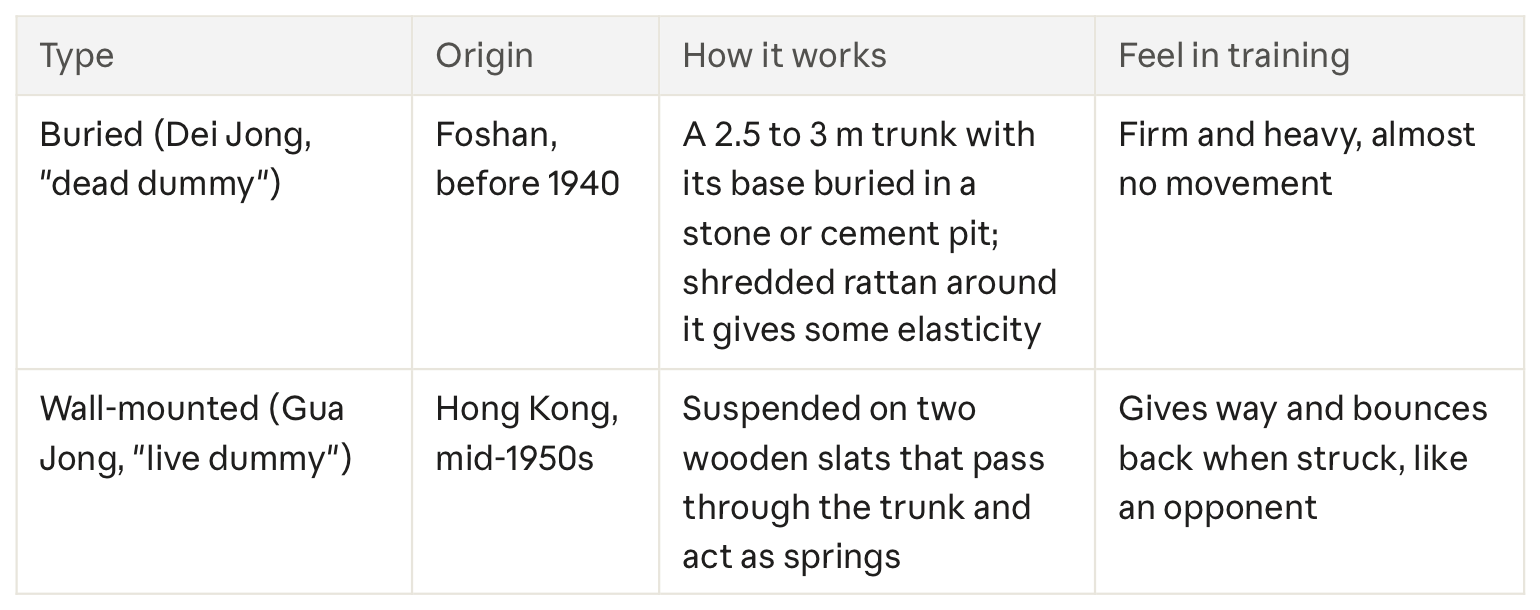


All known dummies dating from before 1940 are of the buried type. The wall-mounted dummy is the model we associate with Ving Tsun today.
Yip Man, Fung Shek and the master carpenters
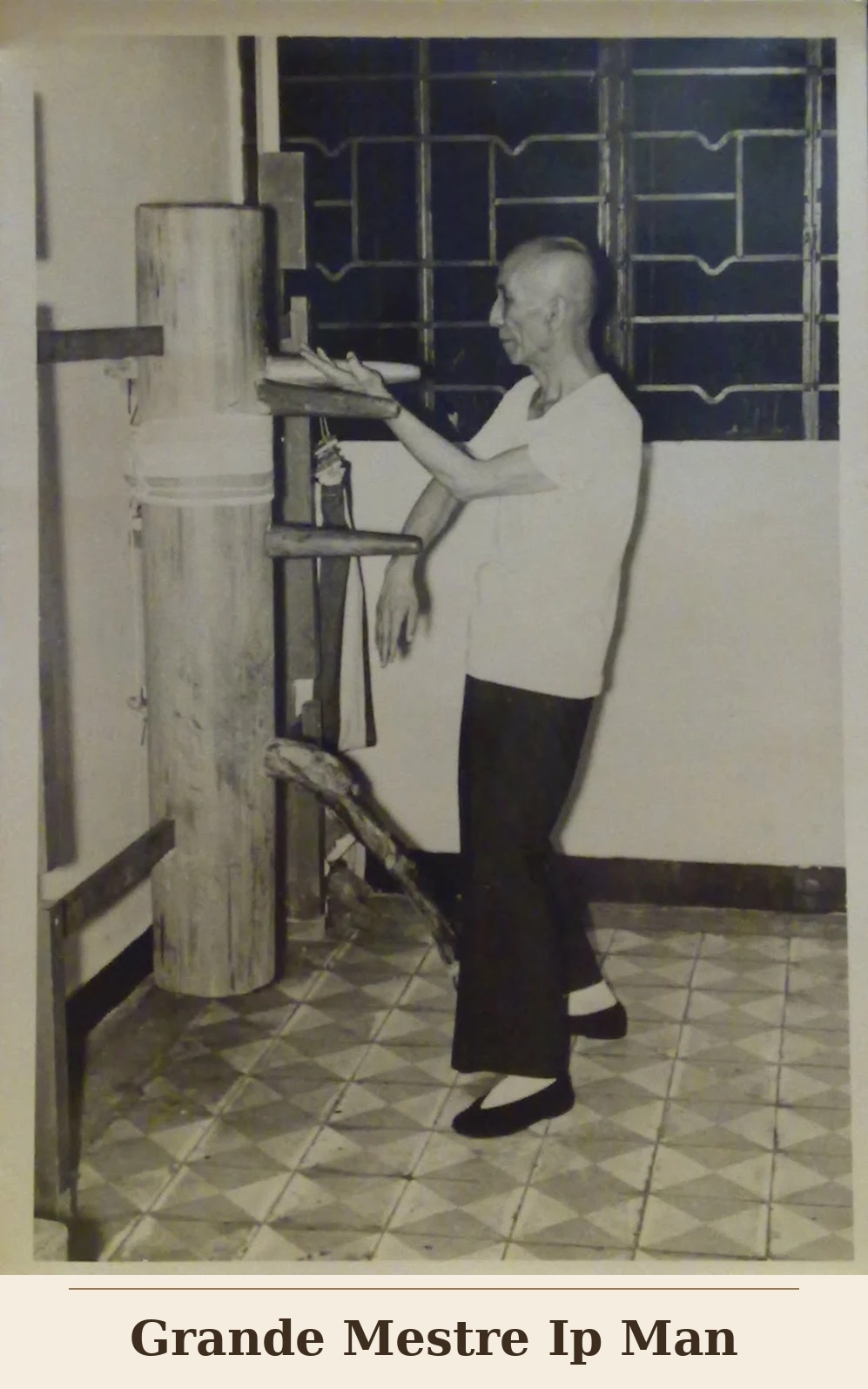
When Yip Man arrived in Hong Kong in 1949, he faced a practical problem. In the city's buildings and rented apartments it was impossible to bury a three-metre trunk in the ground.
The solution came from working with a carpenter named Fung Shek. Instead of burying the dummy, they hung it on a wall frame, supported by wooden slats that act as springs. The prototype was delivered in 1956. Yip Man used it for the rest of his life, and today it is on display at the Ip Man Tong in Foshan. Fung Shek made only 10 to 12 dummies before leaving the trade in the early 1960s.
Other craftsmen followed in his footsteps:
Ho Leun experimented with arms that moved in and out of the trunk. The idea spoiled contact training, and he went back to solid wood.
Koo Sang measured Fung Shek's original dummy and reproduced it for decades, until he retired in the 1990s. His dummies remain the benchmark for many practitioners.
The dummy in the Wong Shun Leung method
For Sifu Wong Shun Leung, the dummy had a very clear purpose: to teach recovery, that is, how to correct the mistakes everyone makes in combat. It was not a tool for conditioning the arms, nor a substitute for Chi Sau, nor a set of sequences to be applied to the letter. It offers ideas, not recipes.
The dummy has a trunk with three arms on two levels and one leg in front. It moves only a few centimetres, which forces the practitioner to move around it, working on distance, timing, footwork and power.
The form is divided into eight sections:
1. Taan Da: recovering by reusing a failed attack; introduction of Gaan Sau and Kwan Sau. 2. Paak Sau: deflecting and controlling the centreline.
3. Waang Geuk: low Bong Sau, Man Sau and side kick.
4. Po Paai Jeung: Jat Sau and palm strikes.
5. Soh Sau: essential sequence and low heel kick (Dang Geuk).
6. So Tui: second low Bong Sau and sweeping kick.
7. Bong Choh Sau: Biu Sau, Wu Sau and Fak Sau.
8. Gaan Sau and Dang Geuk: redirecting, creating space to kick, and controlling kicks with the arms.
In Wong Shun Leung's method, the first 60 movements, up to Po Paai Jeung, are learned before Biu Ji. The complete form comes later. As for the number of techniques, there is debate over whether there are 108 or 116; counting every movement, there are about 180. For Sifu Wong, the number did not matter. What mattered was that it worked.
The legacy
From the trunk buried in the courtyards of Foshan to the dummy suspended in Hong Kong apartments, the Muk Yan Jong changed shape without ever losing its purpose. It remains the most honest partner in the hall: it does not forgive a wrong angle, a misjudged distance or a step out of place.
At Ving Tsun Portugal, the wooden dummy is part of every practitioner's path in Azeitão, Lisbon and Setúbal. Not as a museum piece, but as a silent teacher.
Sources
The story of Ip Man's wooden dummy (Kung Fu Tea)
Muk Yan Jong, David Peterson (wslwingchun.com) Ving Tsun Portugal · vingtsunportugal.com